Should You Run a PPSR Check Before Buying a Boat?
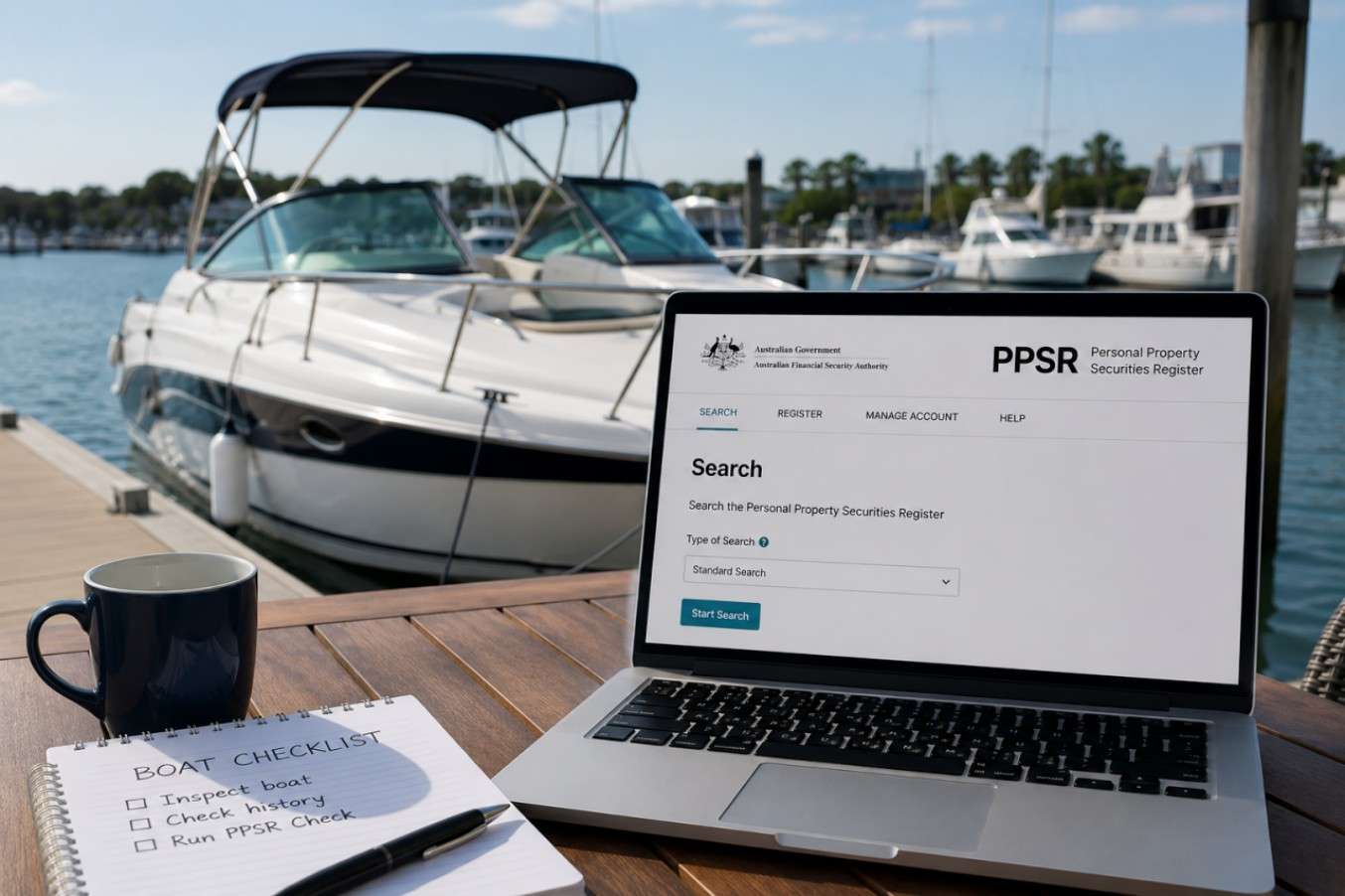
Boats attract far less scrutiny than cars, yet they carry the same risks and often a higher price tag. Finance owing, stolen hulls, and mismatched identification numbers all catch buyers out. A PPSR Asset Check takes minutes and settles the question before you commit. Here is why it matters on the water.
Key Takeaways
- Yes, always check before paying for a boat.
- Finance owing can lead to repossession.
- Boats use a HIN rather than a VIN.
- Boat registration differs in every state.
- Check the trailer and motor separately too.
The Short Answer Is Yes
A boat is personal property in the same way a car is. If a lender holds a registered security interest over the vessel, that claim follows the asset rather than the person selling it. Hand over the money and the financier can still take the boat.
The market is large enough that this happens regularly. Data from the Boating Industry Association shows Australia has more than 2.5 million people licensed to drive a powerboat and close to one million registered vessels, plus countless unregistered paddle craft. Plenty of those change hands privately every year.
Private sales are where the exposure sits. There is no dealership standing behind the transaction, no cooling off period, and no warranty. The seller may not even realise a finance registration is still active if a previous loan was never formally discharged.
Boats Use a Different Identifier
This trips up buyers who have only ever purchased a car. Vehicles use a VIN, while watercraft use a Hull Identification Number, commonly called a HIN or BoatCode.
The number is usually moulded into the hull or engraved on a plate near the starboard aft corner. Guidance from Transport WA explains that the HIN is recorded in a database used to prevent stolen vessels being re registered, and to list the vessel on the PPSR so second hand buyers can check for outstanding financial obligations.
Before searching, locate and photograph:
- The HIN on the hull and on the Australian Builders Plate.
- The engine serial number stamped on the outboard or block.
- The trailer VIN if a trailer forms part of the sale.
PPSR boat search service at PPSR Asset Check runs against the HIN, which is the identifier the register recognises for watercraft.
Theft Is a Genuine Problem
Vessel theft rarely makes headlines, yet the figures are substantial. More than $11 million worth of boats and personal watercraft are stolen in Australia each year, with fishing and ski boats the most frequently targeted.
Stolen vessels are often moved interstate and rebirthed with altered numbers, leaving the buyer without the boat or their money once the original owner is identified. Queensland alone has more than 250,000 registered recreational boats, which gives a sense of how many vessels are circulating and how appealing they are as targets.
Physical checks help alongside the search. Look closely at the HIN plate for signs of tampering, grinding, or fresh adhesive. If the number on the hull does not match the registration papers or the engine records, treat that as a reason to walk away rather than a paperwork error to sort out later.
State Registration Rules Complicate Things
Unlike vehicles, boat registration is handled separately by each state and territory, and the systems do not talk to each other in the way many buyers assume. Requirements around HINs also vary between jurisdictions.
That fragmentation is precisely why a national register matters. A PPSR search covers registered security interests across the country regardless of which state the vessel was previously registered in. Understanding security interests sets out how those claims work in practice.
What a Search Will Not Tell You
A PPSR certificate confirms the financial and legal position. It does not assess whether the hull is sound or the engine has been maintained, which is a separate job entirely.
A marine surveyor covers that ground. Advice published by resource describes surveying as a detailed and specialised business, warning that the eventual cost of making a craft shipshape may be many times greater than the surveyor’s fee. Listings platforms carry thousands of private and dealer vessels at any time, so build both checks into your process before shortlisting. Run them together and you have covered the two risks that actually cost money.
Timing and Value
Run the search before any deposit, ideally while you are inspecting the vessel. Boats frequently sell for tens of thousands of dollars, so the cost of a search is trivial against the exposure.
Context helps here. Analysis from Composites Australia notes Queensland leads with roughly 274,000 registered vessels, followed by New South Wales at around 241,000, with 85 per cent of registered boats under six metres. Research covered by UNSW found Sydney Harbour alone hosts more than 17,000 recreational vessels.
The sector is sizeable in its own right. Marine Business News reports that personal watercraft are the fastest growing segment of the registered fleet, while figures compiled put national industry turnover at $9.64 billion across a recent financial year. Second hand vessels make up a large share of that activity.
Conclusion
Buying a boat should be the start of good weekends, not a legal headache. Locate the HIN, run the search before you pay, arrange a survey, and keep the certificate on file. If you need help searching a vessel, contact us and our team will guide you through it.
FAQs:
Do I need a PPSR check when buying a boat?
Yes. A search reveals finance owing, stolen listings and other claims registered against the vessel.
What number do I use to search a boat?
Use the Hull Identification Number, usually found on the hull or the Australian Builders Plate.
Can a boat be repossessed after I buy it?
Yes, if finance remains registered against the vessel the lender may still take lawful possession.
Does a PPSR check cover the boat trailer?
Not automatically. Trailers carry their own identifier and generally require a separate search to verify.
Is a PPSR search the same as a marine survey?
No. A search covers financial claims, while a survey assesses hull condition and mechanical soundness.
Where is the HIN located on a boat?
Commonly on the starboard aft corner of the hull, and on the Australian Builders Plate.